

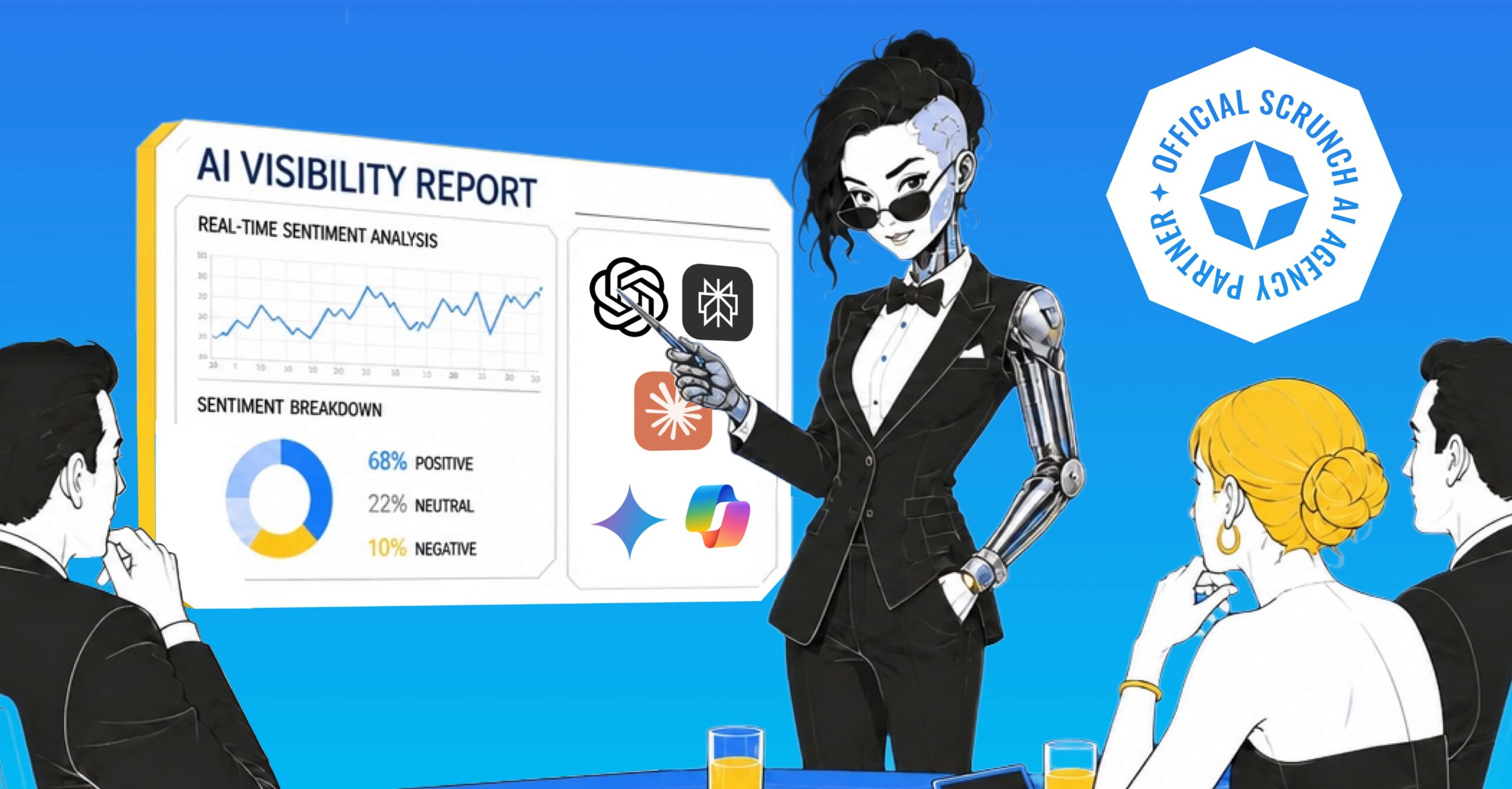


AW is one of the first beta partners with Scrunch AI, helping clients measure and improve their AI visibility.
Imagine this: Right now, someone is asking ChatGPT or Gemini to recommend a product, service, or provider in your space. Do you know if your brand is showing up?
The scenario isn’t that unlikely, with over 40% of Americans using AI chatbots to search for information. Yet many marketers have no idea if their brand is part of the conversation.
That’s why Austin Williams has accepted Scrunch AI’s invitation to be one of its first beta partners. Scrunch is a leading platform for monitoring brand presence across AI ecosystems, giving our teams real-time access to how AI platforms reference, describe, and position brands like yours.
Read on to learn what AI visibility is, why it matters, and how to improve your brand’s. (And when you’re ready, contact us to request a complimentary AI Visibility Assessment.)
What is AI visibility — and why does it matter?
As you probably guessed, AI visibility refers to how your brand appears when someone asks an AI platform a question relevant to your products, services, or industry. It includes recommendations, comparisons, and sentiment, and goes well beyond users simply asking for information about your brand by name.
In fact, AI visibility matters most in the brand discovery phase, when users don’t know they need your services. Your brand needs to show up when someone is searching for a free checking account, top graduate programs, or the best physical therapists nearby because they haven’t made a decision yet.
If AI tools are omitting you from these competitive round-ups and comparisons, describing your brand inaccurately, or not surfacing you at all, that’s a gap your competitors may already be filling.
How to improve AI visibility
“AI is a discovery surface, but the strategies needed to improve it aren’t entirely new,” says Andrew Catalano, AW’s managing partner. “Brands that win won’t abandon what’s already working because users still rely on traditional search and social media. And a strong presence on those channels pays off twofold, because when it comes to AI visibility, solid SEO and social media strategies actively work to improve it.”
But like anything else you want to improve, it makes sense to start with a baseline. An AI Visibility Assessment from Austin Williams gives you a clear, data-backed view across three categories:
- Visibility benchmarking: How often your brand is referenced by platforms, which ones, and in what context.
- Sentiment analysis: The positive, negative, and neutral ways AI tools describe your brand, as well as any themes and narratives they reinforce.
- Competitive context: How your brand compares to key competitors within AI-generated responses and recommendations.
“There are a lot of companies out there offering AI visibility reports,” says Dan Meyer, AW’s senior director of digital transformation. “What matters most is what you do with that data. The result has to answer the question: Now what? At AW, we answer exactly that. It’s why every assessment we offer includes actionable insights.”
Those actionable insights typically cover the following areas to improve AI visibility.
Web Development and Technical SEO
“AI platforms don’t just read your content; they crawl your site,” explains Meyer. “Data implementation, crawlability, site speed, and content structure all influence whether AI tools can accurately find, interpret, and reference your brand.” Our website development and technical SEO teams can address any foundational issues that determine whether your site is even legible to AI in the first place.”
Answer Engine Optimization (AEO) and Generative Engine Optimization (GEO)
AI queries are more conversational and question-based. Our search strategists and creative teams develop content that provides answers, recommendations, and comparisons, optimizing for AI-integrated search features such as Google AI Overviews, featured snippets, direct answer formats, and voice search. If AI tools are pulling answers from somewhere, we work to ensure they pull from your brand’s content.
Off-site Authority and Reputation
AI platforms cite sources with strong trust signals, such as backlinks from credible sites, consistent brand mentions across the web, and positive reviews. We help clients build the kind of off-site authority that makes AI more likely to surface and accurately represent them. It’s one of the reasons why our SEO and ORM strategists work so closely together; ignoring one can kill the other.
Ready to see what AI is saying about your brand and what you can do about it? Contact us to request a complimentary AI Visibility Assessment.